Robots are Going to Trade School
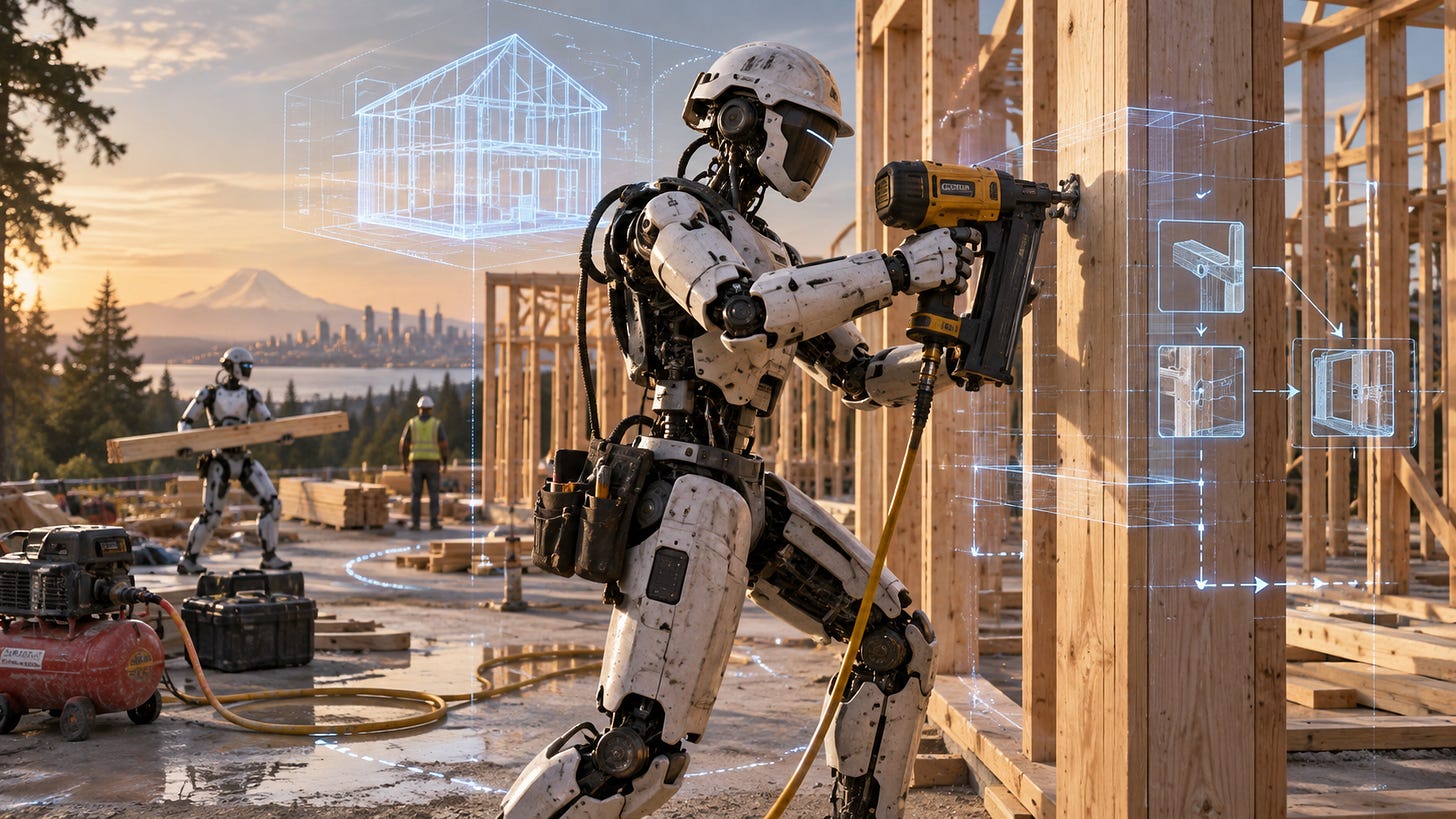
There are two developments in physical AI that, if they converge, could have massive implications for the construction industry.
First: Tool Intelligence
ZINOVA recently introduced “Tool Intelligence,” an approach designed to let robots operate common tools and learn from the physical interaction between tool and material.
The premise is simple: construction workers rarely perform work with their bare hands. They use drills, nail guns, saws, grinders, etc. A robot may not need a perfect human hand if it can reliably pick up a tool, position it correctly and operate it. Simple enough.
Just as valuable though, if not more so, is the data. ZINOVA aims for robots to learn from the feedback created during operations. A tradesperson can feel a drill bind, a screw seat or a saw move into a different material. Force, torque, vibration and resistance all provide information about what is happening at the point of contact. Giving robots access to those signals could help them learn not just how a tool should move, but what successful tool use actually feels like.
Near-Term Implications: Construction robots become useful without waiting a decade (or more) for a perfect general-purpose humanoid; while the bigger opportunity may be the data. Every tool interaction can capture the tool, material, position, force, vibration and result. At scale, that becomes a machine-readable record of how physical work gets done.
In a sense, robots are going to trade school, learning construction one tool and one operation at a time.
Second: Reasoning on the Road
May Mobility is attacking a different problem. A major challenge in self-driving has always been the enormous variety of roads and situations a vehicle may encounter. Performing well in a heavily mapped and tested environment is one thing. Arriving somewhere new and figuring it out is another.
May Mobility is betting that world models and reasoning can help close that gap. Instead of relying only on situations the vehicle has seen before, the system tries to understand the environment, consider how it might change, and choose an appropriate action.
The goal is to build a system capable of applying what it has learned to situations it has not explicitly seen before.
Near-Term Implications: if this approach works, autonomous vehicles (and perhaps other machines) could become easier to scale. The moonshot idea is that machines move from memorizing the physical world toward understanding it.
What the Future May Hold:
The game changer for the construction industry is the convergence of these two approaches to physical. Imagine a robot arriving at a jobsite it has never seen before, to build a house it has never built, on a slab it has never encountered. The lumber is imperfect, a compressor has been left in its path, one wall is slightly out of position, and the plans changed yesterday.
A sufficiently capable world model could allow the robot to understand the site as it exists, compare it with the intended design and reason through what needs to happen next. It might recognize that the bottom plate needs to be repositioned before framing continues, reject a badly warped stud, wait for a worker to clear its path or adjust after detecting that a nail did not seat properly. The important shift is that the robot would not simply be replaying a task it had been trained to perform. It would be interpreting a dynamic situation, just like a human would.
Combine machines that can reason through unfamiliar environments with machines that know how to use tools, and you get something construction has never had: a worker that can learn once, show up anywhere, and adapt in real-time. That is the inflection point where construction robots stop being prototypes and start ushering in physical abundance.